




|
ABHANGA:
A devotional song composed in the Marathi language expressing the longing and love of a devotee for God.
ABHISHEK: A ritual bathing offered as
worship (puja) to a statue or other representation of a
deity.
ABSOLUTE: The highest Reality; supreme
Consciousness; the pure, untainted, changeless Truth.
AMRIT: 1) The nectar of immortality; the
divine nectar that flows down from the sahasrara when the
Kundalini is awakened. 2) An area in Siddha Yoga meditation
ashrams and centres where refreshments can be purchased.
ANNAPURNA: (lit., filled with nourishment)
1) The great Shakti depicted as the goddess of nourishment
and abundance. 2) The dining halls in both Gurudev Siddha
Peeth in Ganeshpuri, India and Shree Muktananda Ashram in
South Fallsburg, New York.
ANUGRAHA: 1) Grace; one of the five functions
of the Lord that ultimately culminates in liberation. 2)
The original building of Shree Muktananda Ashram in South
Fallsburg.
ARATI: 1) A ritual act of worship during
which a flame, symbolic of the individual soul, is waved
before the form of a deity, sacred being, or image that
embodies the light of Consciousness. 2) The name of the
morning and evening prayer that is sung with the waving
of lights, in honour of Bhagawan Nityananda, twice each
day in Siddha Yoga ashrams.
ARJUNA: One of the heroes of the Indian
epic Mahabharata, considered to be the greatest warrior
of all. He was the friend and devotee of Lord Krishna, who
revealed the teachings of the Bhagavad Gita to him on the
battlefield.
ASANA: 1) A hatha yoga posture practised
to strengthen and purify the body and develop one-pointedness
of mind. 2) A seat or mat on which one sits for meditation.
ASHRAM: The dwelling place of a Guru or
saint; a monastic retreat site where seekers engage in spiritual
practices and study the sacred teachings of yoga.
ATMAN: Divine Consciousness residing in
the individual; the supreme Self; the soul.
AUSTERITIES: 1) Rigorous spiritual practices.
2) Abandonment of the pursuit of worldly pleasure for the
purpose of spiritual attainment.
AVADHUTA: An enlightened being who lives
in a state beyond body-consciousness and whose behaviour
is not bound by ordinary social conventions.
BABA: A term of affection and respect
for a saint or holy man.
BADE BABA: (lit., elder father) An affectionate
name for Bhagawan Nityananda, Swami Muktananda's Guru.
BHAGAVAD GITA: (lit., song of God) One
of the world's spiritual treasures and an essential scripture
of India; a portion of the Mahabharata in which Lord Krishna
instructs his disciple Arjuna on the nature the universe,
God, and the supreme Self.
BHAGAWAN: (lit., the Lord) One endowed
with the six attributes or powers of infinity: spiritual
power, righteousness, glory, splendour, knowledge, and renunciation.
A term of great honour. Swami Muktananda's Guru is known
as Bhagawan Nityananda.
BHAJAN: A Hindi devotional song in praise
of God.
BHAKTA: A devotee, a lover of God; a follower
of bhakti yoga, the path of love and devotion.
BHAKTI: The path of devotion; a path to
union with the Divine based on the continual offering of
love and the constant remembrance of the Lord.
BHASMA: Ash from a sacred fire ritual
(yajna), charged with the power of mantra. Bhasma is used
to draw three horizontal stripes on the forehead and other
parts of the body, representing the three qualities of nature
reduced to ash by spiritual practices and the power of grace
BINDI: A red dot worn between the eyebrows
marking the location of the third eye, the eye of inner
vision or spiritual wisdom.
BLUE PEARL: A brilliant blue light, the
size of a tiny seed, that appears in meditation; it is the
subtle abode of the inner Self.
BRAHMA: The absolute Reality manifested
as the active creator of the universe, personified as one
of the three gods of the Hindu trinity. The other two are
Vishnu, who represents the principle of sustenance, and
Shiva, who represents the principle of destruction.
BRAHMAN: In Vedic philosophy, the absolute
Reality or all-pervasive supreme Principle of the universe.
BRAHMIN: A caste of Hindu society whose
members are by tradition priests and scholars.
CHAITANYA: 1) The fundamental, all-pervasive,
divine Consciousness. 2) When used in reference to a mantra,
chaitanya means that the mantra is enlivened with grace
and thus has the capacity to draw one's mind spontaneously
into meditative stillness.
CHAKRA: A centre of energy located in
the subtle body where the subtle nerve channels converge
like the spokes of a wheel. Six major chakras lie within
the central channel. When awakened, kundalini shakti flows
upward from the base of the spine through these six centres
to the seventh chakra, the sahasrara, at the crown of the
head.
CHITI: The power of universal Consciousness;
the creative aspect of God.
CONSCIOUSNESS: The intelligent, supremely
independent, divine Energy, which creates, pervades, and
supports the entire universe.
DAKSHIN KASHI: (lit., south field) A beautiful,
twenty-five-acre field in Gurudev Siddha Peeth, the Siddha
Yoga ashram near Ganeshpuri, India. The field is ringed
by a tree-lined path, which is used for walking contemplation.
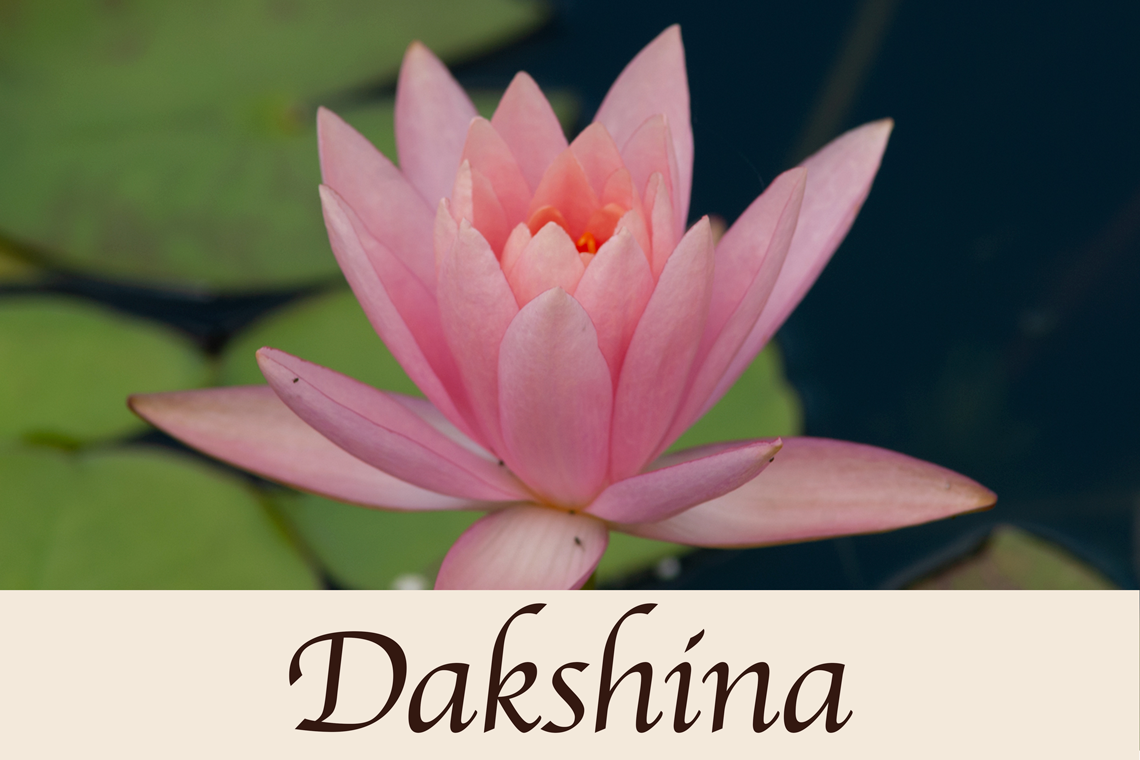
DAKSHINA: An offering or gift to God or
the Guru. Traditionally, when one seeks the teachings or
blessings of a saint, one brings an offering; this act of
giving invites grace. The practice of giving dakshina is
an expression of gratitude and love for what has been received
on the spiritual path.
DARSHAN: Seeing or being in the presence
of a saint, a deity, or a sacred place.
DEVA: A deity or god.
DEVI: The great mother Goddess; the beloved
of Shiva who represents Shakti, or cosmic energy.
DHARANA: A centring technique; a spiritual
exercise that leads one to the experience of God within.
DHARMA: Essential duty; the law of righteousness;
living in accordance with the divine will. The highest dharma
is to recognise the Truth in one's own heart.
DIKSHA: Yogic initiation; spiritual awakening
of a disciple by the grace of the Master.
DISCIPLE: One who has received initiation
from a spiritual master and then follows the path shown
by the master.
DIVYA DIKSHA: The bestowal of divine initiation,
shaktipat.
DIWALI: A four-day festival, falling in
October-November, celebrated by displaying lights and worshipping
Lakshmi, the goddess of wealth and prosperity.
DRISHTI: Vision, usually in the context
of seeing with the outlook of God.
DURGA: The fierce aspect of the universal
Shakti or divine Mother, who destroys limitations and evil
tendencies. She is often depicted as the eight-armed warrior
goddess who rides a tiger and carries
EGO: In yoga, the limited sense of "I"
that is identified with the body, mind, and senses; sometimes
described as "the veil of suffering."
ENLIGHTENMENT: The final attainment on
the spiritual path, when the limited sense of "I"
merges into supreme Consciousness.
GANESH: The elephant-headed god, also
known as Ganapati. Son of Lord Shiva and Goddess Parvati,
he is worshiped at the beginning of any undertaking and
in many festivals as the god of wisdom, the destroyer of
sorrows, and the remover of obstacles.
GRACE: The infinite power of divine love
that creates, maintains, and pervades the universe. When
awakened within a seeker by a Siddha Guru, this power leads
the seeker to Self-realisation.
GUNAS: The three basic qualities of nature
that determine the inherent characteristics of all created
things. They are sattva (purity, light, harmony, intelligence);
rajas (activity, passion); and tamas (dullness, inertia,
ignorance).
GURU: A spiritual master who has attained
oneness with God and who is able both to initiate seekers
and to guide them on the spiritual path to liberation. A
true Guru is required to be learned in the scriptures and
must belong to a lineage of masters..
GURU CHOWK: The open-air meditation hall
adjoining the courtyard in Shree Gurudev Siddha Peeth, the
Siddha Yoga ashram in Ganeshpuri, India.
GURU GITA: (lit., song of the Guru) A
sacred text consisting of mantras that describe the nature
of the Guru, the Guru-disciple relationship, and techniques
of meditation on the Guru. In Siddha Yoga ashrams, the Guru
Gita is chanted every morning.
GURU PRINCIPLE: The universal power of
grace present as the inner Self of all beings.
GURU PURNIMA: In India, the full moon
of the month of Ashada (July-August) is honoured as the
most auspicious and important of the entire year. This moon's
luminous brilliance and perfect form are seen as expressions
of the Guru's gift of grace and the attainment of Self-realisation.
GURU'S FEET: The Indian scriptures revere
the Guru's feet, which are said to embody Shiva and Shakti,
knowledge and action, the emission and reabsorption of creation.
Powerful vibrations of shakti flow from the Guru's feet.
They are a mystical source of grace and illumination, and
a figurative term for the Guru's teachings.
GURU'S SANDALS: The Indian scriptures
revere the Guru's feet, which are said to embody Shiva and
Shakti, knowledge and action, the emission and reabsorption
of creation. Powerful vibrations of shakti flow from the
Guru's feet. They are a mystical source of grace and illumination,
and a figurative term for the Guru's teachings.
GURUKULA: In Vedic times, spiritual aspirants
would serve the Guru at his house or ashram for a period
of time, studying the scriptures, and practising self-inquiry
and other spiritual disciplines under the guidance of the
Master. Siddha Yoga ashrams are modelled on these Gurukulas
of old.
HANUMAN: A huge, white monkey, son of
the Wind, and one of the heroes of the Ramayana. Hanuman's
unparalleled strength was exceeded only by his perfect devotion
to Lord Rama, for whom he performed many acts of magic and
daring.
HATHA YOGA: Yogic practices, both physical
and mental, performed for the purpose of purifying and strengthening
the physical and subtle bodies.
INNER ENEMIES: The inner enemies spoken
about in Vedanta: desire, anger, delusion, pride, greed,
and envy.
INTENSIVE: The primary Siddha Yoga meditation
program, which was designed by Swami Muktananda to give
spiritual initiation by awakening the kundalini energy.
JAGADGURU: A world teacher; a great Guru.
JAPA: Repetition of a mantra, either silently
or aloud.
JNANA: True knowledge.
JNANESHWAR MAHARAJ: (1275-1296) Foremost
among the saints of Maharashtra and a child yogi of extraordinary
powers. His verse commentary on the Bhagavad Gita, the Jnaneshvari,
written in the Marathi language, is acknowledged as one
of the world's most important spiritual works. He also composed
a short work, the Amritanubhava, and over one hundred abhangas,
or devotional songs in Marathi, in which he describes various
spiritual experiences following the awakening of kundalini.
JYOTA SE JYOTA: A chant; an invocation
to the Guru asking for the flame of divine love in the disciple's
heart to be kindled with the Guru's own heart flame.
KARMA: (lit., action) 1) Any action--physical,
verbal, or mental. 2) Destiny, which is caused by past actions,
mainly those of previous lives.
KASHMIR SHAIVISM: A branch of the Shaivite
philosophical tradition, propounded by Kashmiri sages, that
explains how the formless supreme Principle, known as Shiva,
manifests as the universe. Together with Vedanta, Kashmir
Shaivism provides the basic scriptural context for Siddha
Yoga meditation.
KRISHNA: (lit., the dark one) The eighth
incarnation of Lord Vishnu. The spiritual teachings of Lord
Krishna, called "the dark one" because his skin
was deep blue, are contained in the Bhagavad Gita, a portion
of the epic Mahabharata.
KRIYA: A physical, mental, or emotional
movement initiated by the awakened kundalini. Kriyas purify
the body and nervous system, thus allowing a seeker to experience
higher states of consciousness.
KUNDALINI: (lit., coiled one) The primordial
Shakti, or cosmic energy, that lies dormant in a coiled
form in the muladhara chakra at the base of the spine. Through
the descent of grace (shaktipat), this extremely subtle
force, also described as the supreme goddess, is awakened
and begins to purify the entire being. As Kundalini travels
upward through the central channel, She pierces the various
chakras, finally reaching the sahasrara at the crown of
the head. There, the individual soul merges into the supreme
Self and attains the state of Self-realisation. See also
CHAKRA, SHAKTIPAT.
LIBERATION: Freedom from the cycle of
birth and death; the state of realisation of oneness with
the Absolute.
MAHABHARATA: An epic poem that recounts
the struggle between the Kauravas and Pandavas over the
disputed kingdom of Bharata, the ancient name for India.
Within this vast narrative is contained a wealth of Indian
secular and religious lore. The Bhagavad Gita occurs in
the latter portion of the Mahabharata.
MAHARASHTRA: A state on the west coast
of central India, where Gurudev Siddha Peeth, the mother
ashram of Siddha Yoga meditation, is located. Many of the
great poet-saints lived in Maharashtra and the Samadhi Shrines
of Bhagawan Nityananda and Swami Muktananda are there.
MAHASAMADHI: 1) A realised yogi's conscious
departure from the physical body at death. 2) A celebration
on the anniversary of a great being's departure from the
physical body. 3) A shrine erected at the place where a
yogi has taken mahasamadhi.
MALA: A string of beads used to facilitate
a state of concentration while repeating a mantra.
MANTRA: The names of God; sacred words
or divine sounds invested with the power to protect, purify,
and transform the individual who repeats them. A mantra
received from an enlightened Master is filled with the power
of the Master's attainment.
MAYA: The power that veils and obscures
the true nature of the Self and creates a sense of differentiation.
It makes the universal Consciousness, which is One, appear
as duality and multiplicity.
MUKTI: Liberation from the cycle of birth
and death; freedom from the sense of duality and limitation.
MURTI: (lit., embodiment; figure; image)
A representation of God or of a chosen deity that has been
sanctified and enlivened by worship. A murti can be a symbolic
embodiment of the presence of God or a recognisable human
figure, as in the image of a saint.
NADA: Spontaneous inner sounds that may
be heard during advanced stages of meditation; nada may
take the form of sounds such as bells, the blowing of a
conch, and thunder.
NADI: A channel in the subtle body through
which the vital force flows.
NAMA SANKIRTANA: Group chanting of the
name of the Lord.
NATARAJ: (lit., king of the dance) A name
of Shiva, referring to the dancing Shiva. The object of
his dance is to free all souls from the fetters of illusion.
NAVARATRI: (lit., nine nights) A festival
celebrating the worship of the divine Mother, Shakti, in
the three forms of Durga/Kali, Lakshmi, and Saraswati. It
begins with the new moon of September-October and continues
for nine nights.
OM: The primal sound form which the universe
emanates; the inner essence of all mantras. Also written
aum.
OM NAMAH SHIVAYA: (lit., Om, salutations
to Shiva) The Sanskrit mantra of the Siddha Yoga lineage;
known as the great redeeming mantra because of its power
to grant both worldly fulfilment and spiritual realisation.
Om is the primordial sound; Namah is to honour or bow to;
Shivaya denotes divine Consciousness, the Lord who dwells
in every heart.
PADUKAS: The Guru's sandals, objects of
the highest veneration. Vibrations of the inner shakti flow
out from the Guru's feet, which are a mystical source of
grace and illumination and a figurative term for the Guru's
teachings. The Guru's sandals are also said to hold this
divine energy of enlightenment.
PRADAKSHINA: The act of worshipful circumambulation
(walking clockwise around a holy temple, shrine, or place).
PRANA: The vital life-sustaining force
of both the body and the universe.
PRANAM: To bow; to greet with respect.
PRASAD: A blessed or divine gift from
God or the Guru.
PUJA: Worship; actions performed in worship;
also, an altar with images of the Guru or deity and objects
used in worship.
PUNYATITHI: The anniversary of a great
being's death.
PURNAHUTI: (lit., full or complete offering)
The culmination of any celebration, especially a saptah
or a yajna. The final chant of a purnahuti is an arati,
an invocation to the Guru entreating him to kindle the flame
of divine love in the disciple's heart. Tradition states
that to attend a purnahuti is to gain the merit of the entire
celebration.
RAGA: In Indian music, a series of five
or more notes upon which a melody is based; a particular
melody. Ragas evoke particular moods in the listener and
are often performed to resonate with a season or time of
day.
RAKHI DAY: This festival has its origins
in an ancient folk custom: sisters affectionately tie a
rakhi, or bracelet, on the wrists of their brothers who,
in turn, promise always to protect them. To celebrate this
day, many Siddha Yoga meditation students offer each other
rakhis, representing a bond of love and protection.
RAM: (lit., one who is pleasing, delightful)
The seventh incarnation of Lord Vishnu, Rama is seen as
the embodiment of dharma and is the object of great devotion.
He is the central character in the Indian epic Ramayana.
RAMA: (lit., one who is pleasing, delightful)
The seventh incarnation of Lord Vishnu, Rama is seen as
the embodiment of dharma and is the object of great devotion.
He is the central character in the Indian epic Ramayana.
RAMAYANA: One of the great epic poems
of India; attributed to the sage Valmiki, the Ramayana recounts
the life and exploits of Lord Rama. This story, so rich
with spiritual meaning, has been told and retold down through
the ages by saints, poets, scholars, and common folk.
RANGOLI: A design, usually geometric,
drawn on the ground in front of a house or other dwelling
in the colours of the morning sun, to represent inner awakening.
RASA: 1) Flavour, taste. 2) A subtle energy
of richness, sweetness, and delight.
RUDRA: The Lord as destroyer, a form of
Lord Shiva. As the fierce aspect of God, Rudra inspires
both great love and great fear among his worshipers.
RUDRAKSHA: Seeds from a tree sacred to
Shiva, often strung as beads for malas. Legend has it that
the rudraksha seed was created from the tears of Lord Rudra,
thus endowing it with great spiritual power.
SADGURU: A true Guru; divine Master.
SADGURUNATH MAHARAJ KI JAY: A Hindi phrase
that means "I hail the Master who has revealed the
Truth to me!" An exalted, joyful expression of gratitude
to the Guru for all that has been received, often repeated
at the beginning or end of an action.
SADHANA: 1) A spiritual discipline or
path. 2) Practices, both physical and mental, on the spiritual
path.
SAHASRARA: The thousand-petaled spiritual
energy centre at the crown of the head, where one experiences
the highest states of consciousness.
SAMADHI: The state
of meditative union with the Absolute; the state of final
absorption in God.
SAMADHI SHRINE: The final resting place
of a great yogi's body. Such shrines are places of worship:
permeated with the saint's spiritual power, and alive with
blessings.
SANKALPA: Thought, intention, or will
directed toward a specific outcome.
SANNYASA: 1) Monkhood. 2) The ceremony
and vows of monkhood.
SAPTAH: (lit., seven) A term introduced
by Swami Muktananda to refer to the continuous chanting
of the name of God, which also may be accompanied by dancing
in a circle in a series of measured steps as an act of devotion
and a joyful experience of meditation in motion. Saptahs
were often held in the ashram for seven days at a time.
SATSANG: (lit., the company of the Truth)
The company of saints and devotees; a gathering of seekers
for the purpose of chanting, meditation, and listening to
scriptural teachings or readings.
SELF: Divine Consciousness residing in
the individual, described as the witness of the mind or
the pure I-awareness.
SELF-REALISATION: The state of enlightenment
in which the individual merges with pure Consciousness.
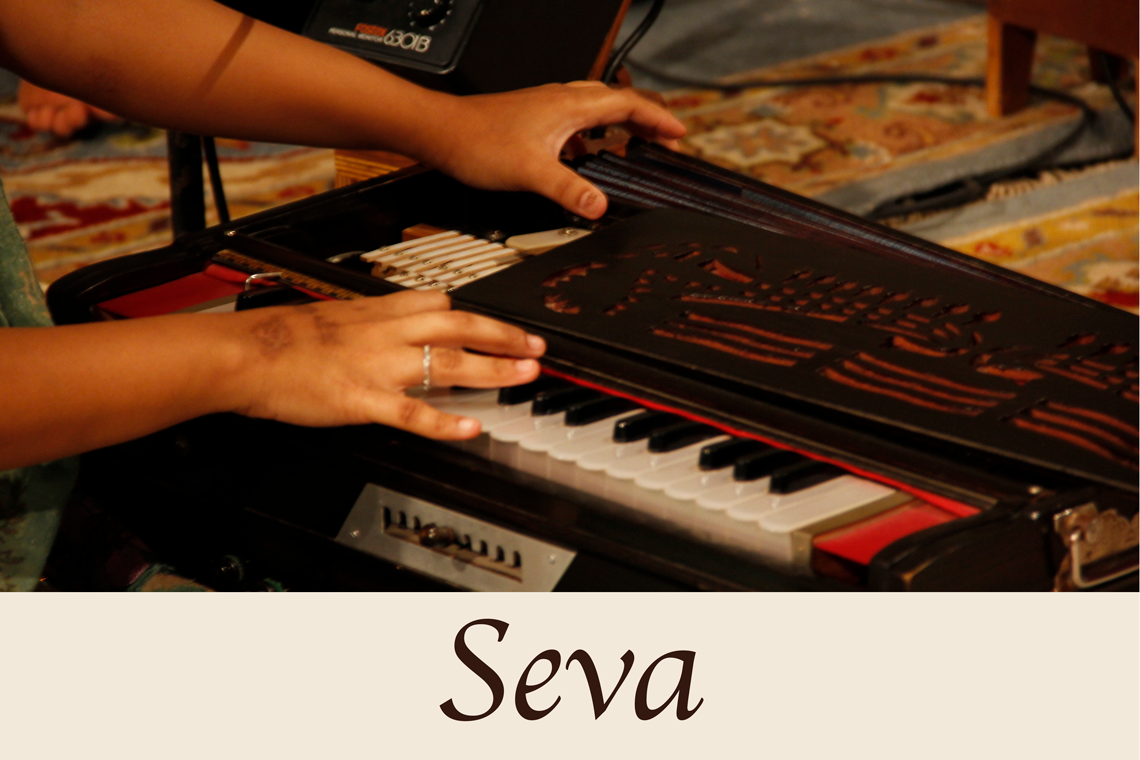
SEVA: (lit., service) Selfless service;
work offered to God, performed without attachment and with
the attitude that one is not the doer. In Siddha Yoga ashrams,
Guruseva is a spiritual practice, and students seek to perform
all of their tasks in this spirit of selfless offering.
SEVITE: One who performs seva.
SHAKTI: Spiritual power; the divine cosmic
power that creates and maintains the universe; may be defined
as the goddess Shakti.
SHAKTIPAT :
(lit., descent of grace) Yogic initiation in which the Siddha
Guru transmits spiritual energy to the aspirant, thereby
awakening the aspirant's dormant kundalini shakti.
SHIVA: The all-pervasive supreme Reality;
also, one of the Hindu trinity of gods, who carries out
the act of destruction or dissolution.
SHIVARATRI: (lit., night of Shiva) The
night of the new moon in late February that is especially
sacred to Lord Shiva. Devotees repeat the mantra Om Namah
Shivaya throughout the night; on this night each repetition
is said to equal the merit of a thousand repetitions.
SHRI: 1) A term or respect that means
sacredness, abundance, beauty, grace, and auspiciousness,
and signifies mastery of all these. 2) Lakshmi, the goddess
of beauty and prosperity.
SIDDHA: A perfected yogi; one whose experience
of unity-consciousness is uninterrupted.
SIDDHA GURU: One who has attained the
state of enlightenment and who has the capacity to awaken
the dormant spiritual energy of a disciple and guide him
or her to the state of the Truth.
SIDDHA MASTER: One who has attained the
state of enlightenment and who has the capacity to awaken
the dormant spiritual energy of a disciple and guide him
or her to the state of the Truth.
SPIRITUAL PRACTICES: Activities that purify
and strengthen the mind and body for the spiritual path.
Siddha Yoga practices include chanting, meditation, mantra
repetition, hatha yoga, seva (selfless service), and contemplation.
SUBTLE BODY: The second of four bodies
within a human being (the physical, subtle, causal, and
supracausal bodies), which is experienced in the dream state.
SUSHUMNA: The most important of all the
nadis; the central channel, which extends from the base
of the spine to the crown of the head. It is the pathway
of the awakened kundalini.
SUTRA: Aphorism; a condensed and cryptic
statement that usually can be understood only through commentary.
In India, the major points of an entire philosophical system
may be expressed in a series of sutras.
SWAMI: A term of respectful address for
a sannyasi, or monk.
SWAMIJI: A term of respectful address
for a sannyasi, or monk.
TANDRA: The state of higher consciousness
between sleeping and waking that is experienced in meditation.
TAPASYA: 1) Austerities. 2) The experience
of heat that occurs during the process of practising yoga.
The heat is generated by friction between the senses and
renunciation. It is said that this heat, called "the
fire of yoga," burns up all the impurities that lie
between the seeker and the experience of the Truth.
TATTVAS: In Kashmir Shaivism, the basic
categories or principles of the process of universal manifestation
from pure Consciousness to matter; that which is the essence
of each stage of manifestation.
TEMPLE: Swami Muktananda has dedicated
a temple of meditation to his Guru, Bhagawan Nityananda
Temple in both Shree Muktananda Ashram and Gurudev Siddha
Peeth.
THE NAME: A name of God. Silent repetition
or audible chanting of the divine Name is considered to
be the most effective means of redemption in Kali Yuga,
the present age. Chanting and japa open the heart to the
love and joy contained within it.
TURIYA: The fourth, or transcendental
state, beyond the waking, dream, and deep-sleep states,
in which the true nature of reality is directly perceived;
the state of samadhi, or deep meditation.
UPANISHADS: The inspired teachings, visions,
and mystical experiences of the ancient sages of India;
the concluding portion of the Vedas and the basis for Vedantic
philosophy. With immense variety of form and style, all
of these scriptures (exceeding one hundred texts) give the
same essential teaching: that the individual soul and God
are one.
VAIRAGYA: Dispassion; the power of renunciation
by which a yogi is able to pursue the true rather than the
false, the eternal rather than the ephemeral.
VEDAS: Among the most ancient, revered,
and sacred of the world's scriptures, the four Vedas are
regarded as divinely revealed, eternal wisdom. They are
the Rig Veda, Atharva Veda, Sama Veda, and Yajur Veda.
VISHNU: 1) A name for the all-pervasive,
supreme Reality. 2) One of the Hindu trinity of gods, representing
God as the sustainer of the universe. Rama and Krishna are
the best known of His incarnations.
VIVEKA: (lit., discrimination; distinction)
The faculty of discretion that enables a human being to
distinguish between true and false, reality and illusion.
VRITTI: Fluctuation or movement of the
mind; thought.
WITNESS: The transcendental Consciousness
that lies at the root of the mind and from which the mind
can be observed.
YAJNA: 1) A sacrificial fire ritual in
which Vedic mantras are recited while wood, fruit, grain,
oil, yogurt, and ghee are poured into the fire as an offering
to the Lord. 2) Any work or spiritual practice that is offered
as worship to God.
YOGA: (lit., union) The spiritual practices
and disciplines that lead a seeker to evenness of mind,
to the severing of the union with pain, and through detachment,
to skill in action. Ultimately, the path of yoga leads to
the constant experience of the Self.
YOGI: 1) One who practices yoga. 2) One
who has attained perfection through yogic practices.
YOGINI: 1) One who practices yoga. 2)
One who has attained perfection through yogic practices.
|